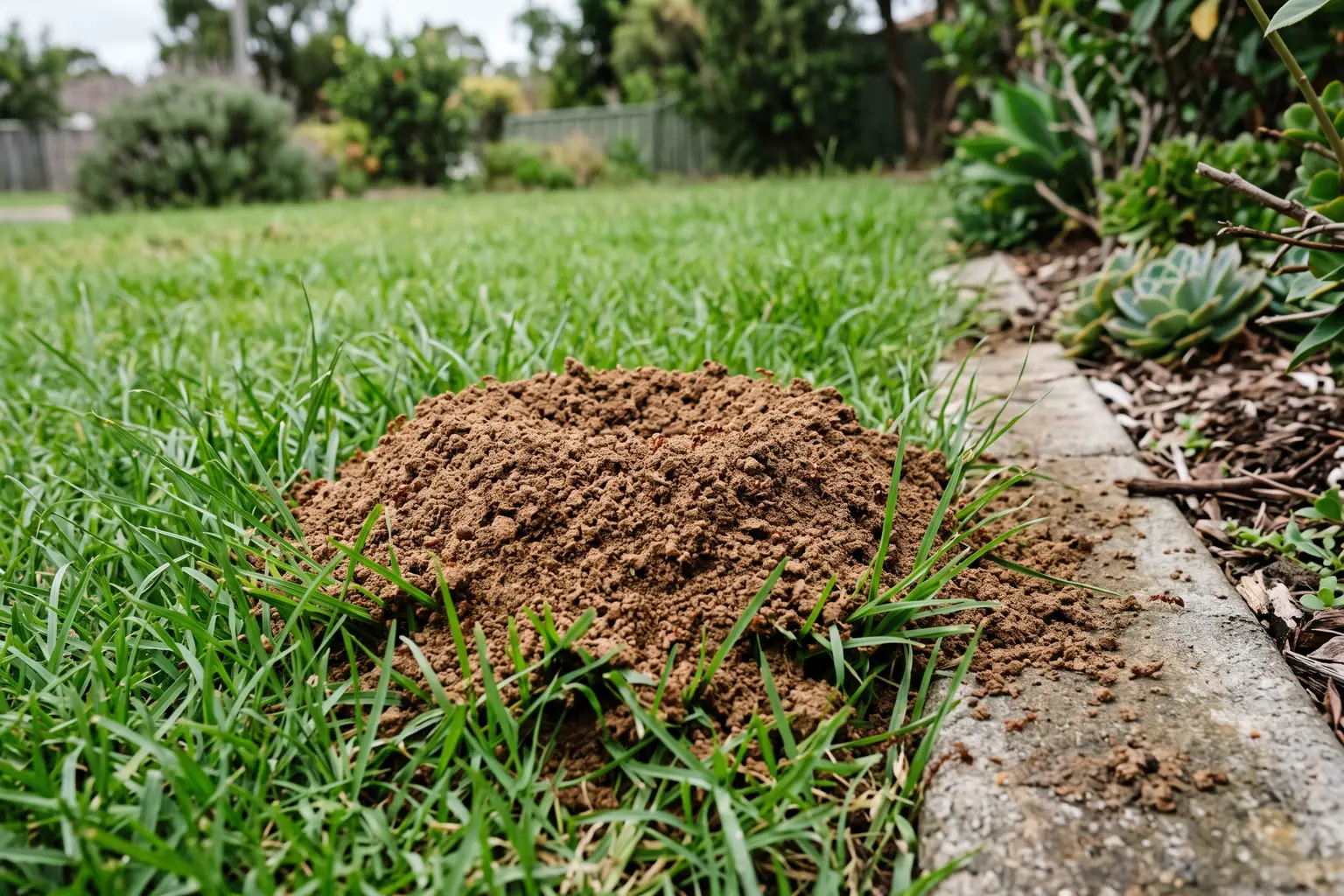
A woman at Shell Cove sent me three photos on a Sunday night of a mound in her new front lawn. Loose brown soil, no hole in the top, about the size of a dinner plate, and it had turned up the week after the turf went down. She'd read something about fire ants coming in on turf and she hadn't touched it.
It was a funnel ant nest, which is what a fresh Illawarra lawn nearly always throws up after rain. But I told her the same thing I'd tell anyone: not touching it and taking photos first was the right call, and it's a habit worth keeping. Fire ants are not in the Illawarra as far as anyone knows. They are close enough, and they move on the same trucks that bring us turf, mulch and pot plants, that every mound deserves ten seconds of looking properly.
Why this is different from every other ant
Everything else on the ant control page is a pest problem. Fire ants are a biosecurity problem. They're notifiable in NSW, the response is run by the NSW Department of Primary Industries, and neither we nor any other pest controller should be treating a suspected nest. The NSW government's advice when they were found near the border was to report suspected sightings on 1800 680 244, and that number hasn't changed.
The reason for the rule is practical rather than bureaucratic. A colony that gets sprayed, dug up or flooded can split into several and move. The eradication program treats an area, not a mound, and it can only do that if the first person who finds a nest leaves it where it is.
How to tell a fire ant from the ants you already have
Three things, in this order.
A mix of sizes in the one nest. Fire ant workers range from about 2 mm to 6 mm and you'll see big and small ones together. Our common ants are one size each. If every ant on the mound is the same size, that's a strong sign it isn't fire ants.
The colour. Dark reddish brown, with a darker, almost black abdomen. Coastal brown ants are a plainer, lighter brown all over. Meat ants are bigger, with a purplish red head and a dark body, and they live in a big gravelly bare patch, not a soft mound. Bull ants and jumpers are two or three times the size and you'll know them.
The nest. A dome of loose, crumbly, fluffy-looking soil with no visible entrance hole, in open sunny ground, lawn edges, beside paths, along fence lines. Nests can get to 40 cm high in the right conditions, but a new one is a low mound the size of a saucer. The tell is what happens if it's bumped: fire ants boil out in numbers and run up whatever touched the mound. A funnel ant nest, by contrast, is a small volcano with a hole in the top and hardly an ant to be seen.
The sting, which we'd rather you didn't test. Fire ants sting in clusters, it burns, and the marks turn into small white pustules over the next day or two.
The look-alikes in an Illawarra yard
- Funnel ants. The Shell Cove mounds. Sandy volcanoes with a hole in the top, dozens of them across a lawn after rain. Harmless, and a normal ant job.
- Coastal brown ants. Little piles of fine soil between pavers and along the edges of paths. Everywhere on the coast.
- Meat ants. A big flat bare patch of gravelly soil with lots of entrances and large red-headed ants that will bite but not sting.
- Bull ants and jumper ants. Big, single nest holes in the yard, and a sting nobody forgets. Not fire ants, but treat them with the same respect.
What to do if you think you've found fire ants in NSW
Leave the nest alone. Don't dig it, spray it, pour anything on it or run the mower over it. Take a couple of photos from a metre or two away, note where it is, keep kids and pets off it, and ring the NSW Biosecurity Helpline on 1800 680 244 to report it. Don't move soil, mulch, pot plants, turf or hay off the property until it's been checked, because that's how the pest travels. If you'd like someone to look first, we'll come out, identify what you've got, and if it needs reporting we'll make the call with you; that's the whole of our fire ant inspection service, and it's deliberately not a treatment.
Where the risk actually comes from
The established infestation is in south-east Queensland. Nests turn up further south when infested material moves, and the state has a control order regulating the movement of things like mulch, woodchips, compost, sand, gravel, soil, hay and other baled products out of that zone into NSW. So the question to ask isn't "are fire ants in Wollongong" but "has anything come onto my block from up north recently". New turf, a load of soil or mulch, potted plants from a big nursery order, hay for the horses. If a mound appears near a recent delivery, that's the one to photograph and ring about.
The Shell Cove mound was a normal funnel ant job in the end. The habit is the part worth keeping: a photo and a proper look before anyone does anything about a new mound. That's the right amount of worry.
Common questions
- Are fire ants in NSW?
- The established infestation is in south-east Queensland, and nests turn up further south when infested material such as turf, mulch, soil or hay is moved. There is no known fire ant population in the Illawarra. Because they travel on the same trucks that bring us landscaping supplies, any new mound that appears after a delivery is worth photographing and reporting on 1800 680 244.
- How do you identify fire ants?
- Look for three things. Workers of mixed sizes in the one nest, roughly 2 mm to 6 mm together, where our common ants are all one size each. A dark reddish brown body with a darker, almost black abdomen. And a swarming response, where bumping the mound brings them boiling out in numbers to run up whatever touched it.
- What does a fire ant nest look like?
- A dome of loose, crumbly soil with no visible entrance hole, usually in open sunny ground along lawn edges, paths and fence lines. A new one is about the size of a saucer and established ones can reach 40 cm high. A funnel ant nest, which is what most fresh Illawarra lawns throw up after rain, is a small volcano with a hole in the top and few ants in sight.
- What should I do if I find a suspected fire ant nest?
- Leave it exactly as it is. Do not dig, spray, flood or mow it, because a disturbed colony can split and move, and the eradication program treats an area rather than a mound. Take photos from a metre or two away, keep children and pets off it, hold any soil, mulch, turf or hay on the property, and ring the NSW Biosecurity Helpline on 1800 680 244.
Need a hand with this in your home? Get a free quote or call 0430 007 651.