A woman at Oak Flats rang about rats in the roof. Scratching above the main bedroom at five every morning, she said, and a smell near the back gutter. Rats was a fair guess. It's what most people guess when a roof starts making noise, and on the phone I half agreed with her.
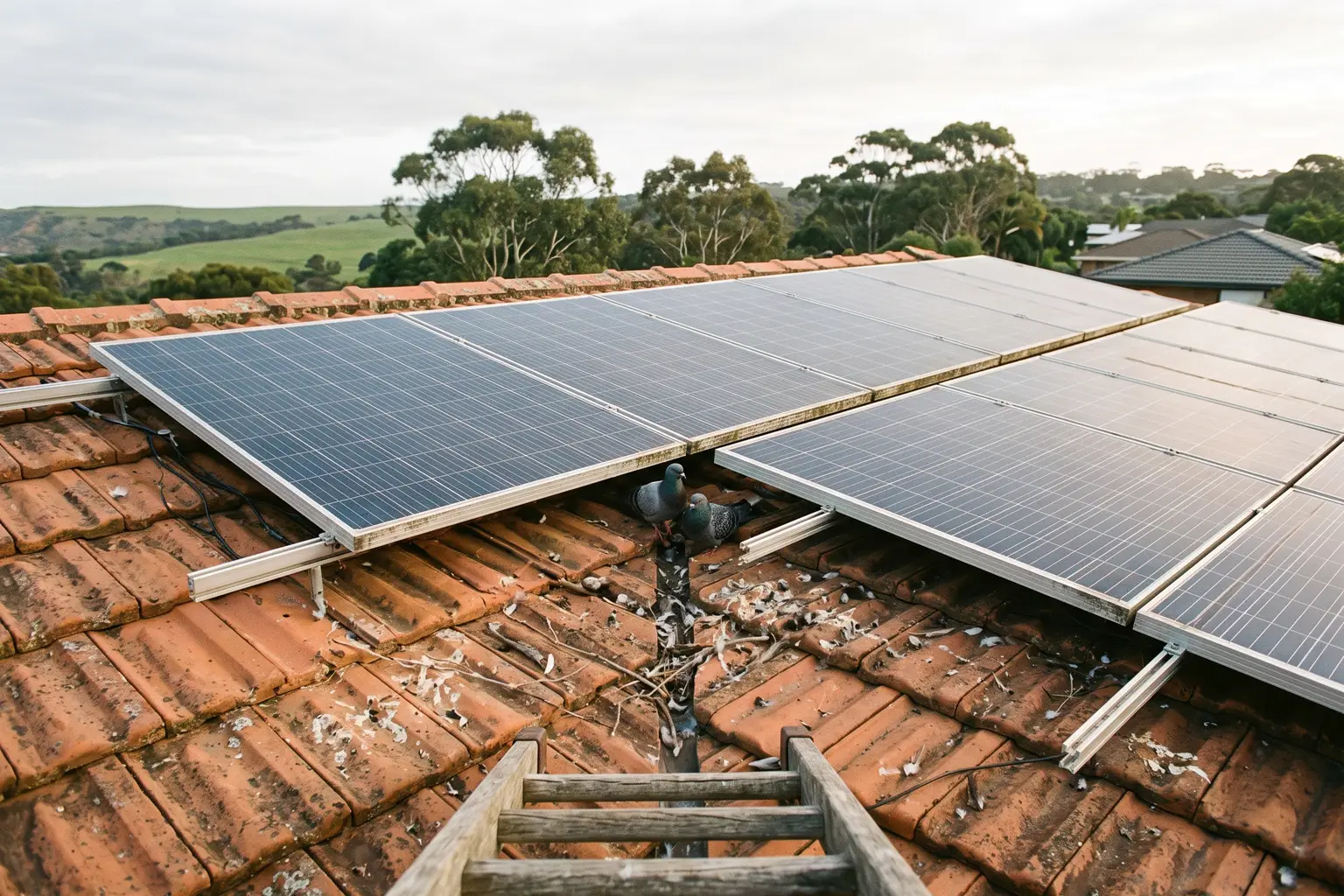
Up the ladder it took about four seconds. Two pairs of pigeons roosting in the gap under her solar array, three nests of twigs and feathers packed against the top row of tiles, and the back gutter behind the panels was more nest than gutter. The white streaks ran from the panels down to the fascia. No rats. The scratching was pigeon feet on tin flashing, which at dawn, through a ceiling, sounds like something with a tail.
Why it's always the solar panels
The gap between a panel and a tile or tin roof is a hundred millimetres or so of shade, dry all year, warm off the roof by mid morning, and out of reach of every cat, currawong and kite in the suburb. Pigeons don't need a hollow or a ledge to nest. A flat sheltered surface does them. So a north-facing array on a roof in Warilla or Fairy Meadow is about the best real estate a pigeon will ever find, and once one pair has raised a clutch there, the cooing brings the next pair.
Spring is when the phone starts. September and October is when they're pairing up and building, and it's when the noise tips people from "there's a bird on the roof" to "there's something living up there".
Rats, possums or pigeons: the five-second version
The three get confused constantly and the fix for each is different, so this is worth getting right before anyone quotes.
Pigeons are a dawn and daytime noise. Cooing, a soft shuffling, the odd flap. Anything heavy that runs across the ceiling at night is not a pigeon. A possum is a thud and a slow walk, mostly at dusk and again before dawn, and usually one animal. Rats are light, fast, and scratch and gnaw, mostly in the dark. If the noise is between about ten at night and four in the morning, read rats or mice or possums in the roof instead of this.
Then look at the gutter under the array and the tiles just below it. Pigeons leave evidence you can see from the yard with a phone zoomed in. Feathers, twigs, and white droppings running down the roof. Rats leave nothing on the outside of a roof.
The Oak Flats job had all three signs and I still nearly quoted it as a rodent job over the phone. Go up and look, or send someone who will.
Clean first, and I mean properly
This is the half of the job that people try to skip, usually because a mesh kit off the internet looks like the whole answer. It isn't, for two reasons.
The first is that pigeon droppings are acidic. Left on tin they eat the coating, left on tiles they stain, and a gutter full of nest material behind a solar array is a gutter that overflows back under the tiles the first time we get a proper east coast low. Meshing over that seals the problem in, where nobody can reach it and the array shades it from ever drying out.
The second is what lives in the nests. Bird mites and lice sit in the nest material and, when the birds leave or the chicks fledge, they go looking for the next warm body. That's the phone call three weeks after a DIY mesh job: "we've got tiny bugs biting us in bed and we can't see them." The nests come out, the area is treated for mites as part of the clean, and then the mesh goes on. Not the other way round.
What the mesh is
A galvanised or stainless skirt clipped around the whole perimeter of the array, following the roof profile so there's no gap at the bottom edge of the tiles where the birds have been walking in. It fixes to the panel frames with purpose-made clips. Nothing is drilled into the panels and nothing is screwed into the roof, which matters for your panel warranty and for the roof not leaking. From the street you don't see it.
The bonus is that the same skirt keeps out rats and possums, which use the same shaded gap for the same reasons. On a house that's had a possum in the ceiling as well, the solar mesh closes one of the entry routes for free. The rest of the roof proofing is a separate walk-round, and it's the same work we do under rodent control.
The birds we won't touch, and the ones we don't need to
Native animals in NSW are protected under the Biodiversity Conservation Act 2016, which the state's own protected species page sets out plainly. That covers every native bird, and every now and then what's under an array is a native, not a feral pigeon. A pair of crested pigeons, once, at Albion Park. In that case we wait until the nest is empty and the young have fledged, then clean and close. Nobody moves eggs or chicks, and we don't harm the birds.
The feral pigeon, the Indian myna and the starling are introduced and not protected, but the plan is still the same one. We don't trap or poison birds and we don't want to. We take the roost away and close the gap, and the pair moves to somebody else's roof. Exclusion is the whole of the bird proofing service, and honestly it's the only version of this job that stays fixed.
What it doesn't fix
Pigeons on the ridge cap or on the gutter edge aren't stopped by solar mesh, because they're not under the panels. That's a spike strip or a wire job on the ledge they're using, and it's quoted separately. A pigeon loft two doors down, or a neighbour who feeds them, is a supply problem we can't do anything about from your roof. The mesh stops them breeding under your array. It doesn't stop them landing on your ridge and looking offended.
What it costs
We quote after a look at the roof, because the price is mostly the size of the array and how much cleaning is under it. A tidy six-kilowatt system with one season of nesting and a twenty-panel array with three years of it are not the same afternoon. The quote is free and we'll tell you on the day if what's up there is birds at all.
The Oak Flats job was a Tuesday morning. Three nests out, the gutter cleared, the tiles washed off, a mite treatment across the top rows, and the skirt clipped on around sixteen panels. She rang the following week to say the five o'clock scratching had stopped. Which it had, because it was never rats.
Need a hand with this in your home? Get a free quote or call 0430 007 651.