
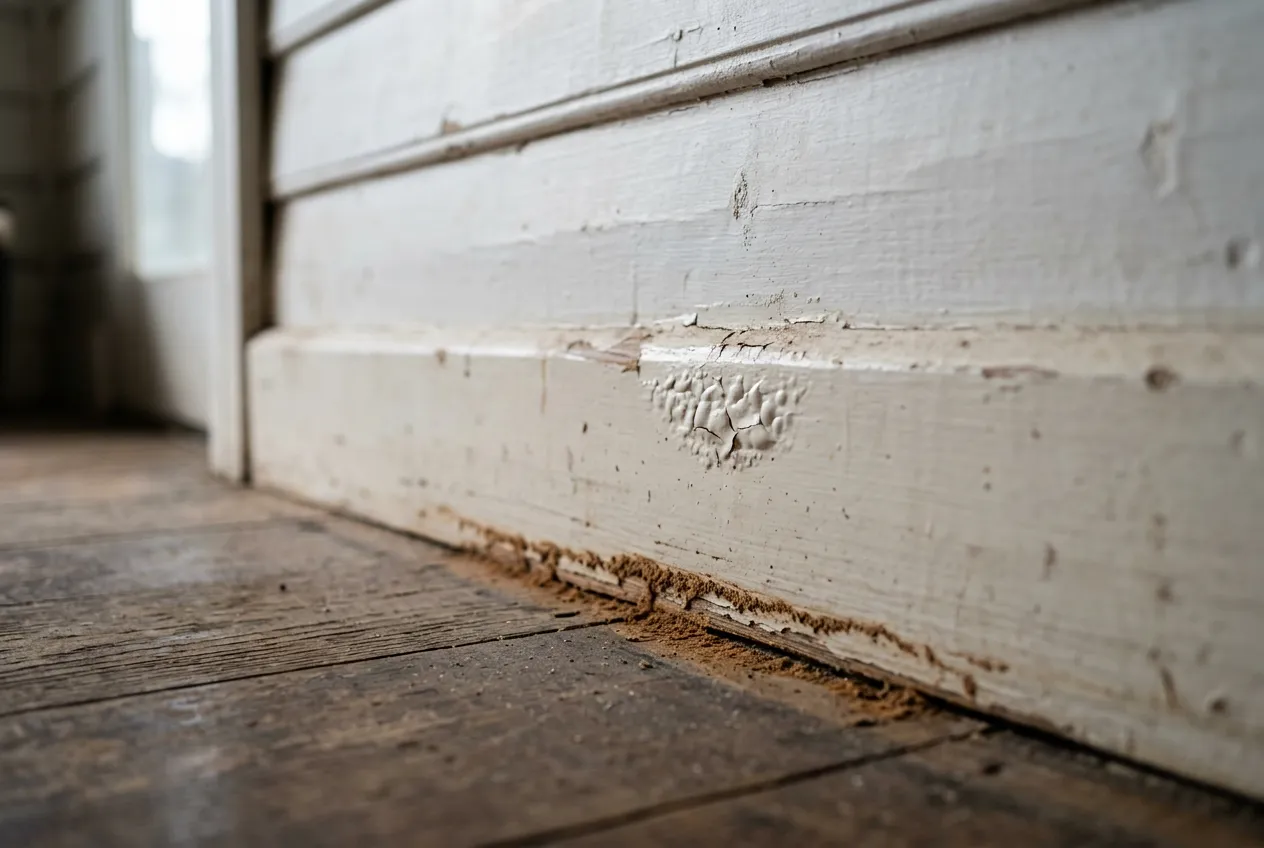
The usual first signs of termites in a house are mud tubes on walls, slab edges or stumps, timber that sounds hollow or has a thin skin over damage, bubbling or warping paint and plaster, and discarded wings near windows or lights. Any one of them can have another cause, so the safe response is to photograph it, leave it undisturbed and book a timber pest inspection.
The guidance from Western Australia's building regulator, BASF's Termidor support pages and CSIRO is consistent on that last point: do not spray, scrape or pull apart suspected workings. The sections below cover what each sign looks like, where to check, and what the inspection involves. Our termite inspection service covers Wollongong, Shellharbour, Kiama and the surrounding suburbs.
The signs and what they may mean
None of the sources rank these by how often they occur in a particular suburb, so the table is a guide to what to check, not a diagnosis.
| What you see | What it may mean | Safe owner check | What an inspector decides |
|---|---|---|---|
| Mud tubes, or mud packed into cracks in timber, wall edges or slab edges | Shelter tubes made by subterranean termites. BASF treats mud tubes as a strong indicator, not automatic proof | Look and photograph. Do not scrape or open them | Whether they are termite workings, whether they are active, and where the termites are getting in |
| Live insects showing in damaged timber | Direct evidence of activity at that spot, if they are termites. Not every termite species attacks structural timber | Stop whatever exposed them and leave the timber alone | Species, how far the activity extends, and the treatment plan |
| Timber that sounds hollow, or has a thin surface over damage | Termites can eat out the inside and leave a thin shell. Wood decay and borers are other possibilities | Note which skirting, frame or floor board. Do not probe or lever it | Non-marking sounding and moisture readings, and whether the timber is still sound enough to carry load |
| Discoloured, damp-looking or warping walls and timber | Possible hidden termite damage, but also a leak or damp problem. CSIRO names bathrooms, laundries and poor drainage as vulnerable spots | Look at accessible surfaces and visible plumbing. Do not remove linings | Whether it is a leak, decay or termites, and whether the lining needs opening |
| Discarded wings, or winged insects near windows and lights | A termite flight can mean a colony nearby. It does not prove the house is infested, and CSIRO says the nest can be many metres away | Photograph the insects and note whether they came from inside or arrived from outside | Whether they are termites and whether the building is affected |
| Small piles of gritty pellets under tiny holes in timber | Possible drywood termite frass, which CSIRO describes as like sand or ground pepper. This needs a different approach from ordinary subterranean termites | Photograph the pellets and holes. Do not dig into the timber | Which pest it is, and whether a standard subterranean treatment applies at all |
A swarm on its own is covered in flying ants or termites, which has the wing, waist and antenna check. In short, termite alates have four equal wings, no waist and straight antennae.
Where to look around an Illawarra house
CSIRO says most termite attacks start from the soil, so the places to check are where timber, damp and soil meet.
- Wall bases, slab edges and stump tops. Look for mud tubes, and for garden beds, paving or stored material piled against the wall that hides the edge.
- Bathrooms, laundries and the rooms next to them. Staining, damp skirting boards and soft door frames show up here first.
- Skirting boards, door and window frames, built-in wardrobes. Look for changes in surface, bubbling paint or distortion.
- Subfloor vents and openings. Blocked vents, damp and timber stored under the house all help termites. Look from a safe position and leave crawling into tight spaces to the inspector.
- Fences, firewood, stumps and old sleepers. Termites in the garden do not necessarily mean termites in the house, and some species are not structural pests, but tell the inspector what you saw.
- Water discharge points. Sprinklers wetting a wall, a leaking tap or air-conditioner drainage near the building all add moisture.
Queensland's building regulator also warns that garden beds, wood chips and attached structures built later can bridge a termite management system, and recommends keeping at least 75 mm clearance below weep holes. That is Queensland guidance and not NSW law, so ask your inspector what applies to your construction. Never block weep holes to keep insects out. The ways a new home's protection is usually undone are listed in how people break a new home's termite barrier.
What to do if you think you have found termites
- Stop disturbing the area. Do not spray household insecticide, scrape open mud tubes, or pull out damaged timber to see how far it goes.
- Photograph from a safe position and note where it is.
- Make a note of any termite system already in the house, past treatments and recent building or landscaping work.
- Book an inspection with a qualified timber pest inspector.
The reason for step 1 is practical. BASF explains that disturbance can make termites relocate and become harder to detect, and the Western Australian regulator tells owners not to use household sprays or remove infested wood. CSIRO's general advice includes tapping timber to find hollow spots, but also says to avoid further disturbance once termites are found. If you already suspect activity, stop at looking.
What needs a licensed technician
- Termite treatment. The Australian Termidor label restricts use of that product to licensed pest control operators, and NSW licences timber pest work that uses pesticides for fee or reward.
- Roof space entry. Switching off a light is not isolation. SafeWork NSW requires all electrical supplies to be identified and an isolation procedure followed, and solar or battery systems need separate consideration. Leave roof voids to someone equipped for them, and any electrical work to a licensed electrician.
- Plumbing leaks found along the way. Damp that comes from a leak needs a licensed plumber.
- Structural damage. If load-bearing timber may be affected, get a separate building or structural assessment before repairs or normal loading resume.
What an inspection covers
Two Australian Standards apply, and they do different jobs. AS 4349.3-2010 covers non-invasive timber pest inspections and reports, the type used for pre-purchase and routine inspections. It starts with a visual inspection and adds non-marking sounding and moisture readings, and it covers subterranean and dampwood termites, borers and wood decay, but not drywood termites or mould. AS 3660.2:2017 is guidance for managing subterranean termites in existing buildings and is not intended for pre-purchase reports.
Before you book, ask which areas will be inspected: house, roof space, subfloor and grounds within 30 metres of the building are the standard's site definition. Anything inaccessible should be listed in the report as not inspected. A building inspection is also not a pest inspection. NSW Fair Trading says a building report may note visible termite damage but will not establish whether termites are still present, and advises getting a pest inspection as well.
How often: CSIRO recommends inspection at least once a year. Some NSW council guidance suggests every 6 to 12 months in higher risk areas, so for a house with damp, past activity or changed landscaping, ask whether six months suits. What an inspection costs is in termite inspection cost in the Illawarra, and the treatment side is in termite treatment cost. If a report found nothing, what no termites found actually means explains how to read it.
If you have seen one of these signs
Send us a photo and where it was through the contact page, or call 0430 007 651, and we will tell you what the next step is.
Sources
- Termites and your home, Government of Western Australia
- Telltale signs of termites, BASF Termidor
- Managing termites, CSIRO
- AS 3660.2:2017 and AS 4349.3-2010, Standards Australia
- Termidor residual label, BASF
Common questions
What are the early signs that my house might have termites?
Mud tubes on walls, slab edges or stumps, hollow-sounding timber, and wall or skirting surfaces that discolour, damp-stain or warp are the usual early signs. Discarded wings near windows or lights can also point to a colony nearby. None of these proves an infestation on its own, so photograph what you see and book an inspection.
Would I know if I had termites?
Not always. Termites work inside timber and can leave a thin outer shell, so the first sign may only show once damage is well advanced. That is why CSIRO recommends a professional inspection at least once a year, not waiting for something to appear.
Can you ever fully get rid of termites?
A colony in or under a house can be treated, but CSIRO notes that control methods generally do not give lasting protection against reinfestation. A termite management system and regular inspections are what keep the risk down after treatment.
What time of year are termites most active?
CSIRO says winged termites leave the nest during humid periods in the warmer months, often at dusk. Termites feeding in timber are out of sight, so a sign can show up at any time of year and the date you notice it says little about when the activity began.
Why do termites suddenly appear?
They rarely appear suddenly. Termites work out of sight, so a sign that looks new, such as a swarm, a mud tube or a soft skirting board, is usually the first visible evidence of activity that has been going on for some time.
Do termites ever just leave?
Do not count on it. Disturbing the workings, for example by spraying them or breaking open a tube, can push termites to relocate and become harder to find. Leave the area alone and have it inspected.
What kills termites instantly?
A household spray is the wrong tool. BASF says disturbing termites can make them relocate and become harder to detect, and its Termidor label restricts use of that product to licensed pest control operators. Leave the area alone and have the activity located and treated by a licensed operator.
How often should a house be inspected for termites?
At least once a year. CSIRO recommends annual inspections, and some NSW council guidance suggests every 6 to 12 months where the risk is higher. Ask the inspector for a written interval that suits your house.
Need a hand with this in your home? Get a free quote or call 0430 007 651.