
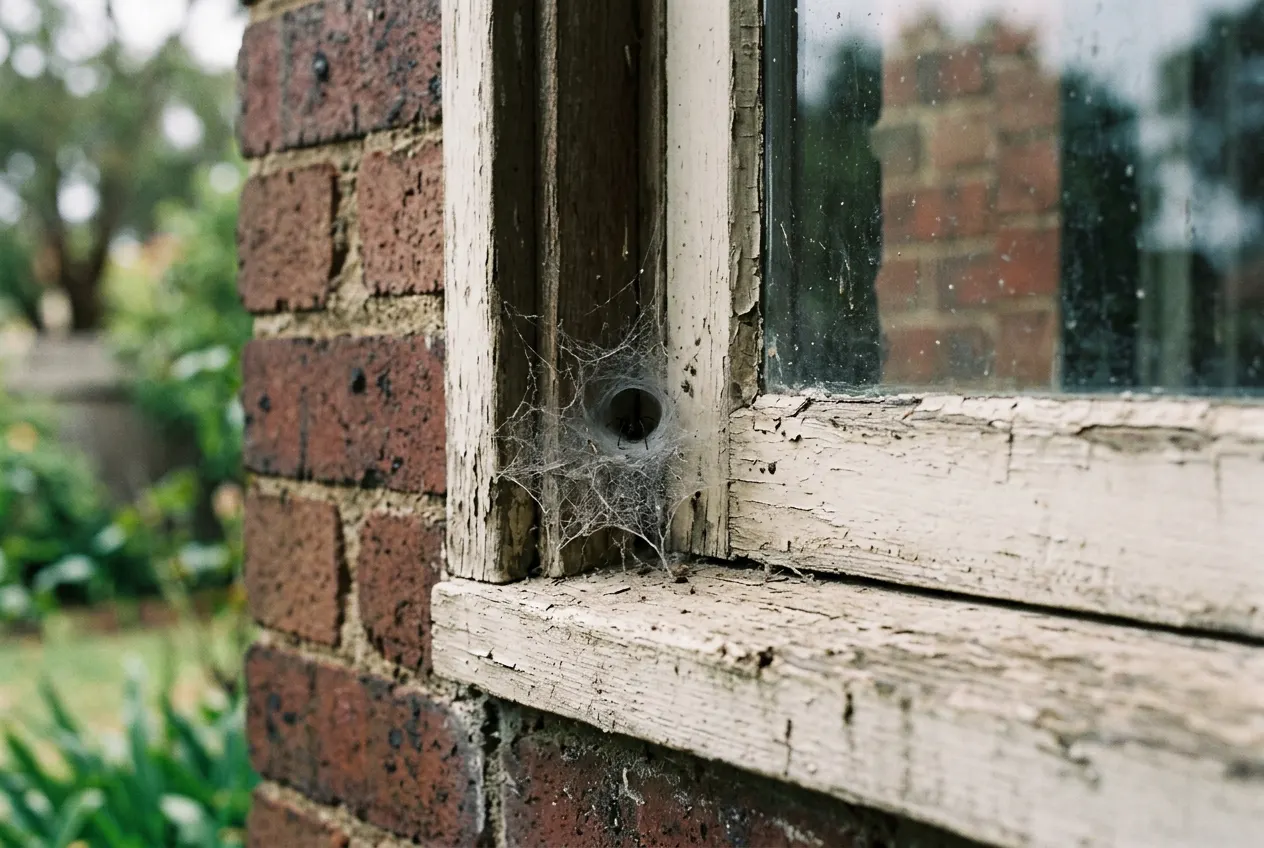
A grey, lacy web spread across a window frame or into a wall crevice, with a tunnel-shaped opening in the middle, is the usual sign of a black house spider (Badumna insignis). The web being funnel-shaped does not make the spider a funnel-web. Black house spiders bite rarely and the bite is usually a painful local problem, but a big black spider that has bitten someone and has not been identified is treated as a funnel-web until a hospital says otherwise.
The facts below come from the Australian Museum, NSW Health, the Australian Venom Research Unit and the Queensland Museum. Spider control is a service we provide in Wollongong, Shellharbour, Kiama and the surrounding suburbs; this post is about what you can sort out yourself first.
What a black house spider and its web look like
The Australian Museum describes a dark brown to black body with a charcoal-grey abdomen that sometimes has faint pale markings, and grey hairs on the front part of the body. Females are about 12 to 18 mm long and males about 9 to 15 mm. Those sizes are not enough to identify one on their own, and the closely related brown house spider is slightly smaller and browner.
The web is the better clue. It is a lacy sheet around one or more tunnel entrances leading to a sheltered retreat. Fresh silk has a fine zig-zag look and older layers go matted and untidy. The silk is made of fine combed strands that snag insects, not sticky glue.
A female normally stays in her web and keeps adding layers. The spiders live about two years. A corner that has been occupied for a while can therefore look heavily webbed without having many spiders in it, so the amount of silk says little about the number of spiders.
Why they set up on window frames and eaves
The Australian Museum records black house spiders on tree trunks, logs, rock walls and buildings, including window frames and wall crevices. They feed on moths, beetles and termites drawn to window and lamp light at night. A frame gives them a protected spot to anchor silk, a retreat and a steady supply of insects. The museum documents window frames and wall crevices. An eave is the same kind of sheltered corner, but not every eave web belongs to this species.
Because the site keeps working for the spider, brushing the web away and doing nothing else tends to bring it back. The things to change are the shelter, the entry points and the insects.
Black house spider, funnel-web, redback or white-tail
| Spider | What to look for | Web and where | If someone is bitten |
|---|---|---|---|
| Black house spider | Dark, robust, grey hairs, sometimes faint pale marks on the abdomen | Lacy layered sheet around a tunnel, often on window frames and in wall crevices | Bites are infrequent and can be painful. Do not assume an unidentified big black spider is this one |
| Funnel-web | Medium to large (1 to 5 cm across the group), glossy and sparsely haired | Usually a silk-lined burrow with trip lines in a moist, sheltered spot. Some live in trees. Males wander at night in warmer months | Medical emergency: call 000, keep still, pressure immobilisation bandage |
| Redback | Female black with an orange-red stripe on the upper abdomen. Males are much smaller | Tangled web in a dry sheltered spot with sticky threads running down to the ground | Cold pack and medical advice. Do not use a pressure bandage |
| White-tail | Long, cigar-shaped reddish-grey body with a pale spot at the tip | Wanders in search of other spiders. Makes only temporary silk retreats | Burning pain, swelling and itch. Ice may ease the pain |
The word "funnel" causes most of the confusion. Black house spiders have funnel-like retreat entrances, and the Australian Museum describes a funnel-like upper retreat in redback webs too. The funnel-web is identified by the spider and where it lives, not by the shape of the opening. Our funnel-web season post covers where funnel-webs shelter on an Illawarra block.
What to do about a bite
- If a big black spider has bitten someone and it has not been reliably identified, call 000. NSW Health directs that big black spider bites in eastern Australia are managed as suspected funnel-web bites in the first period after the bite.
- Keep the person calm and still. Apply a pressure immobilisation bandage along the whole bitten limb, firm like a bandage on a sprained ankle, and splint the limb.
- Leave the bandage on for medical assessment. Do not take it off at home to look at the bite.
- If the spider was reliably identified as a black house spider, the Australian Museum advises a cold pack for the pain (wrapped, not ice against bare skin) and medical attention if symptoms persist. The Poisons Information Centre on 13 11 26 gives individual advice, but it does not replace 000 for a possible funnel-web bite.
Pressure immobilisation is for suspected funnel-web bites. The Australian Venom Research Unit does not recommend it for ordinary spider bites, and NSW Health says not to use a pressure bandage on a redback bite because it can make the pain worse. That is why the identification step matters, and why you should not wait for symptoms while you decide what bit someone.
Sores that people blame on spiders
The sources differ on skin damage. The Australian Venom Research Unit's black house spider page reports an association with at least one case of ulceration and tissue damage. The Australian Museum says skin lesions have developed in a few cases after multiple bites. The Queensland Museum states that no Australian spider is known to have necrotic, tissue-destroying venom. These are different claims, and none of them lets you diagnose a sore from the spiders near it. A sore that is persistent or getting worse needs a doctor, whether or not there are webs around.
What you can safely do yourself
- Check screens and gaps. The Australian Museum and government pest guidance recommend repairing flyscreens and fitting weather strips or draught excluders so fewer spiders and insects get in.
- Cut back unnecessary light right beside windows you use, since the light draws the insects that the spiders feed on. Keep the lighting you need to move around safely.
- Remove accessible silk with a broom or a long-handled duster from stable ground. Wear gloves and do not poke into the tunnel with fingers or tools. Leave an occupied retreat alone if you cannot tell what lives in it.
- Do not climb to a high eave or reach blindly into a crevice to clear a web.
- Wear shoes, long trousers and thick gloves when gardening or moving things that make shelter, and shake out clothing left on the floor.
The Australian Museum also notes that white-tailed spiders prefer other spiders as prey, and that black house spiders are a favoured food. Its advice for managing white-tails is to remove the ones you see and clear the house spider webs they depend on. Clearing webs around rooms people use therefore does some work against both. Our white-tailed spiders post goes into that.
When a pest controller is worth calling
An identified black house spider outside a window nobody uses is not a reason to spray. A controller is a reasonable call when:
- you cannot identify the spider, or you suspect something else;
- spiders keep returning to a doorway, a bedroom window or a play area;
- the webs are out of reach, such as high eaves;
- numbers stay high after you have sealed gaps and fixed screens.
The treatment should suit the spider. Victorian government guidance warns that spraying ground-dwelling spiders can increase their activity and send them into the house, so advice for exposed web builders should not be applied to burrowing spiders.
Before you agree to pesticide work in NSW, check the technician's EPA licence (photo, identity and expiry date, with the EPA public register as a further check), ask what is being treated and why non-chemical steps are not enough, and ask for the full product name and the safety data sheet, which the controller must give you on request. Our guide to getting rid of spiders covers the general approach and spider control is the service page. Costs are on the pricing page.
If you are not sure what you have
Send a photo of the spider and web, and say where it is, through the contact page, or call 0430 007 651. Take the photo from a safe distance and do not handle the spider.
Sources
- Black house spider, Badumna insignis, Australian Museum
- Spiders in the house and garden and White-tailed spider, Australian Museum
- Funnel-web spiders, Australian Museum
- Spiders commonly found in Australia, Australian Venom Research Unit
- NSW Health guideline GL2024_007 (spider bite management), NSW Health
- Technical note 12: spiders, Victorian Department of Health
Common questions
What happens if you get bitten by a black house spider?
The Australian Museum says bites are infrequent and can cause quite painful local swelling, and occasionally nausea, vomiting, sweating or giddiness. It recommends a cold pack for the pain and medical attention if symptoms persist. If the spider was a big black one and nobody identified it, NSW Health treats the bite as a suspected funnel-web bite first: call 000, keep the person still and apply a pressure immobilisation bandage.
How can you tell if a bite is from a spider?
Usually you cannot, unless you saw the spider bite. A sore or lump with no known cause is not good evidence of a spider bite, and the Queensland Museum says no Australian spider is known to have tissue-destroying venom. If a sore is getting worse or not healing, have a doctor look at it instead of assuming a cause.
What is commonly mistaken for a spider bite?
The sources we checked do not give a ranked list, so we will not offer one. What they do support is that a skin lesion cannot be traced to a spider from the presence of spiders nearby. A doctor can look for other causes.
Is a house spider bite bad?
For a black house spider the Australian Museum describes a local reaction that can be painful, and says to seek medical attention if symptoms persist. The bite that needs an emergency response is a big black spider that has not been identified, because a funnel-web cannot be ruled out.
Should I get rid of black house spiders?
Not automatically. The Australian Museum generally recommends leaving garden spiders alone, and government pest guidance notes that spiders eat insects. Removing webs from windows and doorways people use is reasonable, and a pest controller is worth calling when you cannot identify the spider, the webs are out of reach or the numbers stay high after you have sealed gaps and screens.
What are the most common spiders in Australia?
We have no source that ranks them, so we cannot say. The spiders that matter most in an Illawarra house are the ones people confuse: black house spiders, funnel-webs, redbacks and white-tails. The table in this post sets out how each is told apart.
What does it mean to see a spider in your house at night?
Light brings moths, beetles and other insects to windows at night. The Australian Museum records black house spiders feeding on insects drawn to window and lamp light. A wandering dark spider on the floor is a different case, because male funnel-webs walk at night in the warmer months. Do not handle it.
Need a hand with this in your home? Get a free quote or call 0430 007 651.