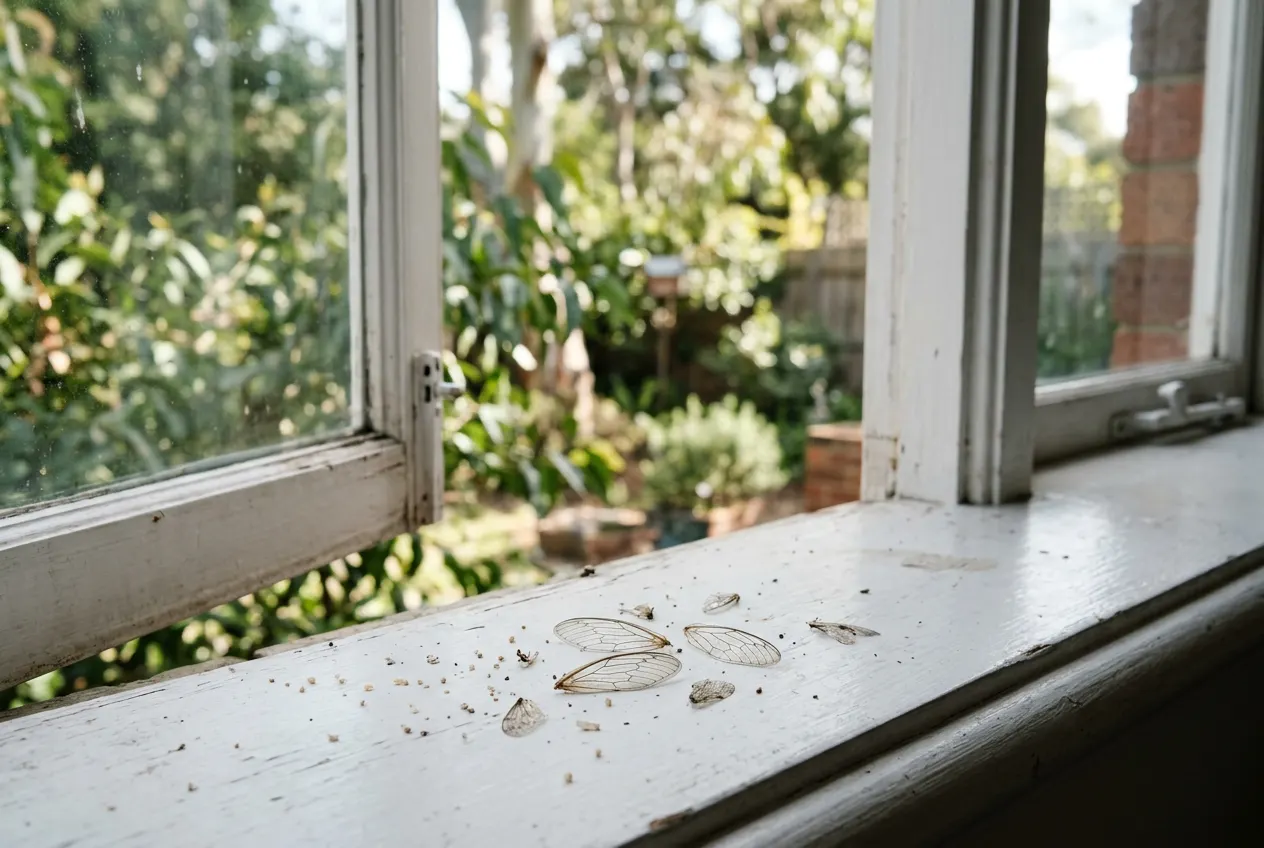
Discarded wings and small piles of grit under timber are evidence of something that has already happened. Shed wings mean winged termites have flown and dropped their wings at or near that spot, but they do not show where the colony is. Gritty pellets under small holes point to drywood termites, while fine flour-like powder beside round holes points to borer beetles instead. Both are worth a photograph and an inspection, not a spray.
This post covers what is left behind after a flight and how to read pale piles of grit. If you are working out whether you have termites at all, start with signs of termites in your house. If you have a live winged insect in front of you, see flying ants or termites.
Wings on a window sill
Winged reproductive termites (also called swarmers or alates) fly out to start new colonies. The Australian Museum describes them as having two pairs of wings of equal size, and CSIRO adds that they are ready to shed those wings after landing. Dispersal flights are linked to warm, humid conditions: CSIRO places flights in humid weather in the warmer months, usually around dusk, and the Australian Museum describes them as usually in warm, humid spring or autumn weather. Those are tendencies, so the date is not a test for what the insects were.
What the wings tell you depends on where they are and what you saw:
- You watched insects come out of a frame, a wall gap or timber. NSW DPI describes discarded wings beneath door or window frames from which termites have emerged. Observed emergence from inside the building is the stronger sign. Note the exact spot and book an inspection promptly.
- Wings appeared, and you saw nothing. Victorian health guidance calls piles of shed wings a good clue to infestation, but CSIRO cautions that the nest may be many metres away. The wings justify a look, not a conclusion that the sill is infested. Note whether there was an outdoor flight at dusk or an open window nearby.
- Wings keep turning up in the same place, or come with damage. Repeated wings, mud tubes, hollow-sounding timber or distorted paint make an inspection a priority.
CSIRO suggests watching flights, particularly any that begin inside, to work out where the termites are launching from. Do not take the wings as a reason to open up the sill or frame.
Gritty pellets or flour-like powder
The first thing to check is the texture.
| Material | What it looks like | What else to check | What to do |
|---|---|---|---|
| Drywood termite droppings (frass) | Small, separate, dry, gritty pellets. CSIRO says like sand or ground pepper. Not a flour-like heap | Pellets under small holes or cracks, sometimes collecting under windows or skirting. The holes can be about 1 mm | Photograph the pile and the timber above it. Do not open the timber |
| Powderpost beetle dust | Fine, smooth, flour-like powder | Round exit holes, commonly 1 to 2 mm, and powder-filled tunnels inside the timber | Ask for a borer assessment, not a termite one |
| Other borer waste | Not always flour-like. Furniture beetle waste can be gritty, like fine salt | Exit holes and the type of timber help identify the borer | Do not name the pest from texture alone |
| Sawdust | Irregular wood particles or fibres, from cutting, drilling or sanding | Recent work nearby is a useful clue, though not proof that insects are absent | Check whether the pile matches building work. Keep any unexplained material for the inspector |
The word "frass" is not exclusive to termites. Government wood preservation guidance uses it for borer waste too. NSW's older inspection guide contrasts termites with powder-producing borers, while CSIRO separately describes drywood termites ejecting gritty pellets, so "termites leave no dust" is not the same as "termites leave no waste". Our post on borers in furniture covers the beetle side.
Subterranean and drywood termites are different problems
CSIRO identifies subterranean termites as the most commonly encountered type in Australia and the cause of most structural termite damage. They usually reach timber through underground galleries or mud shelter tubes. Drywood termites nest and feed inside timber without a connection to the soil, and the clue they leave is dry pellets pushed out of small openings.
| Question | Subterranean termites | Drywood termites |
|---|---|---|
| How do they get to timber? | Underground galleries or mud shelter tubes | They live and feed inside the timber, with no tunnels to soil |
| What clues are there? | Shelter tubes, mud sealing gaps, damaged timber, moisture | Dry granular pellets from small openings |
| Is soil contact needed? | Usually, with exceptions where permanent moisture supports an above-ground nest | No |
| Covered by AS 3660.2? | Yes, for existing buildings | No. Drywood and dampwood termites are excluded |
Two consequences follow. No pile of pellets does not rule out subterranean termites, so do not wait for droppings before investigating mud tubes or damaged timber. And pellets in an upstairs room or a piece of furniture should not be dismissed because there is no route from the soil. NSW DPI describes the West Indian drywood termite (Cryptotermes brevis) as able to keep colonies in small pieces of timber, with several colonies in the same building or timber item, without ground contact or an outside water supply. Do not move a suspect timber item elsewhere before getting advice. The same publication, from 2005, says four drywood species occur in NSW and rarely damage buildings, and notes that it may no longer be current, so it is background and not a way to identify a sample.
What to leave alone
CSIRO explains that several control options depend on finding active termites, and that applying control products without a plan may drive them away for a while. NSW guidance describes spraying exposed termites as counterproductive because it can send them off and make eradication harder.
Do now:
- Photograph before you clean up: a close view and a wider view showing the sill, skirting or timber above the material.
- Note where and when you found it, and whether you saw insects emerge.
- Keep a few loose wings or pellets in a labelled container for the inspector. Do not break timber or tubes to get a sample.
Do not:
- spray exposed termites with household insecticide;
- pull apart skirting, flooring, furniture or structural timber to see how far it goes;
- scrape away mud tubes or dig into tunnels;
- start any treatment before the pest and the extent of activity are known.
If you have already opened timber or broken a tube, stop and tell the inspector what happened.
What needs a licensed technician
Termite treatment does. Service NSW states that commercial termite treatments need an EPA pest management licence, and the EPA says a timber pest management technician licence is being phased in. All EPA pesticide licences appear on its public register. Ask who will do any treatment, under which licence category, and check the individual.
Inspection is a separate question. The sources we read establish licensing for treatment but not a universal inspection-only licence, so do not treat "licensed termite inspector" as proof of competence. AS 3660.2:2017 defines a competent person by training, qualifications and experience. Useful questions before you book:
- Who will inspect, and what timber pest experience do they have?
- Will the report separate observed activity, damage, areas that could not be inspected and recommendations?
- Will suspected drywood termites or borers get their own identification and advice?
AS 3660.2:2017 covers subterranean termites in and around existing buildings. It excludes drywood and dampwood termites and is not intended for pre-purchase timber pest reports, which AS 4349.3 covers. If you suspect drywood termites or borers, say so when you book. What inspections cost is in termite inspection cost in the Illawarra, and a purchase report is covered in building and pest inspection. If an inspection found nothing and you still have wings, what "no termites found" actually means explains how far a report can be relied on.
CSIRO recommends inspection at least once a year. An older NSW publication suggests every six to 12 months where termites are known to be active locally. New signs are a reason to book now, not at the next annual visit.
If you have found wings or pellets
Tell us where you found them and send a photo through the contact page, or call 0430 007 651. Our termite inspections cover Wollongong, Shellharbour, Kiama and the surrounding suburbs.
Sources
- Termites, Australian Museum
- Managing termites, CSIRO
- Termites in NSW, Part 1: Termite biology and Part 2: Termite infestations, NSW DPI (March 2005)
- AS 3660.2:2017, Standards Australia
- Powderpost beetle, Queensland Government
Common questions
Why do termites discard their wings?
Winged reproductive termites fly out to start new colonies and shed their wings after they land. CSIRO notes they are ready to drop them after landing, and the Australian Museum describes the flights as usually in warm, humid spring or autumn weather. Wings are what is left after that flight.
Why do I see termite wings but no termites?
The winged termites flew, landed and dropped their wings, then moved on, and the wings stay behind. Finding wings alone does not show where the colony is. CSIRO says the nest may be many metres away. If you saw insects come out of a frame or wall gap, that is more significant than loose wings, and worth an inspection.
What can be mistaken for termite frass?
Borer dust and ordinary sawdust. Powderpost beetles leave fine, flour-like powder, often next to round exit holes of 1 to 2 mm. Some other borers leave gritty waste as well, so texture alone does not identify the pest. Dust from recent cutting, drilling or sanding nearby is another common explanation.
What are the differences between subterranean and drywood termite droppings?
Subterranean termites are usually found through mud shelter tubes, mud in gaps and damaged timber, not through pellets. Drywood termites push dry, gritty pellets out of small holes and cracks. CSIRO describes them as like sand or ground pepper.
Do termite swarmers mean I have termites?
Not by themselves. Swarmers show that a colony exists somewhere, and CSIRO says it may be a long way from your house. They are more worrying if you see them emerging from inside the building, or if there is timber damage or mud tubes as well. Our flying ants or termites post covers telling swarmers from ants.
What do termites look like when they get wings?
The Australian Museum describes reproductive termites with two pairs of wings of equal size. CSIRO notes straight rather than elbowed antennae. Flying ants have wings of unequal size and elbowed antennae. Use several features together, especially if the insects are damaged.
How big is termite frass?
CSIRO says drywood termites expel pellets through openings that may be only about 1 mm wide, and NSW DPI describes the pellets as sand-grain sized. We have no source for a more exact size.
What should I do if I find wings?
Photograph them where they lie before you clean up, note whether you saw insects emerge or the wings simply appeared, and keep a few in a labelled container for the inspector. Do not spray, and do not pull timber apart to see how far it goes. Book an inspection if the source is inside, the wings keep appearing, or there is damage.
Need a hand with this in your home? Get a free quote or call 0430 007 651.