
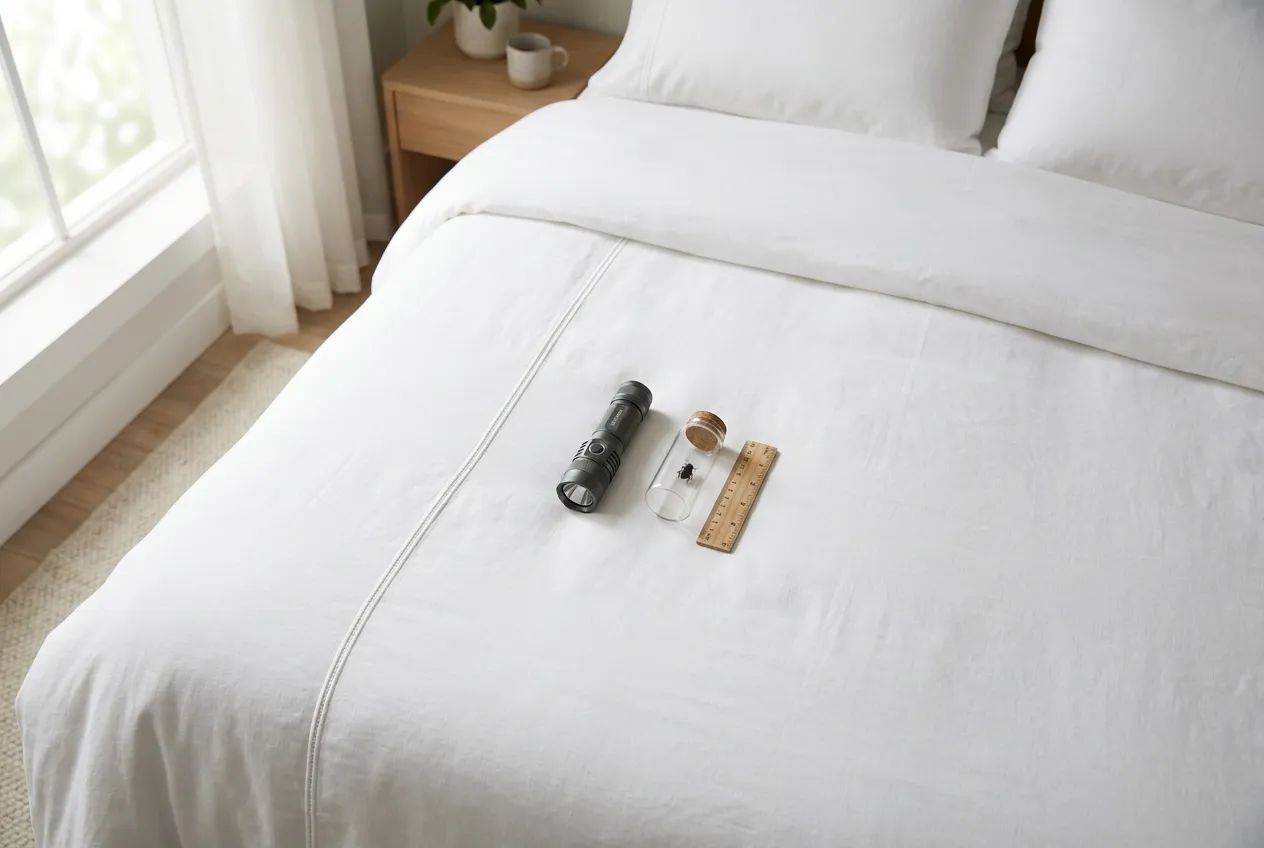
Small bugs in a bed that turn out not to be bed bugs are usually carpet beetle larvae, bird mites, booklice, fleas or dust mites. Each has one clue you can check without any tools beyond a torch: bed bugs are flat, oval and 4 to 6 mm as adults, carpet beetle larvae are hairy, bird mites are under 1 mm and move fast, booklice live near damp, fleas jump, and dust mites do not bite at all.
Identify the animal before spraying anything. The treatments are different, and some of the culprits cannot be fixed with an insecticide at all. If it does turn out to be bed bugs, see bed bug treatment and bed bugs after a holiday.
Get a specimen, not a rash
A bite pattern cannot tell you which animal did it. NSW Health notes that bed bugs are not known to spread disease, but that itching, disturbed sleep and infection from scratching can still be a real problem. Victorian Health adds that reactions vary between people.
- Inspect mattress seams, bed frame joints, nearby skirting boards and furniture with a torch.
- Look for live insects, and for dark spotting, eggs or shed skins, which are the signs that point to bed bugs.
- Catch a specimen and photograph it next to a ruler. Keep it in a clear sealed container, or lift very small crawling specimens with clear adhesive tape.
A bird mite case in Wollongong in December 1996, reported in the Australian Government's Communicable Diseases Intelligence bulletin, was settled this way: the resident collected the specimens with tape and a microscope identified them. No power, gas or water isolation is needed for any of this. Do not take off socket covers or go into the roof space to look for a specimen.
Six candidates side by side
| Candidate | What it looks like or does | Bites people? | Strongest clue |
|---|---|---|---|
| Bed bug | Flat, oval, wingless, adults about 4 to 6 mm | Yes | Live bugs, dark spotting, eggs and cast skins around the mattress seams or nearby hiding places |
| Carpet beetle larva | Small hairy grub, with hairy cast skins | Not a blood feeder, but the hairs can cause allergic skin reactions | Larvae and damage on wool, feathers, fur and other animal-based textiles |
| Bird mite | Under 1 mm, very mobile, may look translucent, reddish or dark | Yes, but cannot complete its life cycle on people | A bird nest recently used near the room. They crawl, not jump or fly |
| Booklouse | About 1 to 2 mm, slightly transparent brown, wingless | No | Damp, mouldy conditions near paper, furniture or windows |
| Flea | Small, jumps | Yes | Cats, dogs, pet bedding and activity at floor level |
| Dust mite | About 0.25 mm, microscopic | No | Allergy symptoms from bedding and furnishings, with no visible biting insect |
Carpet beetle larvae
Hairy larvae and hairy cast skins point to a beetle that feeds on materials, not to bed bugs. The Australian Museum says the larvae damage clothing, blankets, furniture, furs and carpets, and that adult beetles live mostly outdoors, so they keep coming back inside. That is why spraying alone disappoints and why the museum's emphasis is on frequent, thorough vacuuming, especially along edges and under furniture.
Check wool, feathers and fur first, then carpet edges and concealed areas under furniture. The full story is in carpet beetles in the house.
Bird mites
Bird mites come indoors looking for a blood meal after birds leave a nest. They bite but cannot complete their life cycle on people. That case involved a resident in East Corrimal with severe itching at night. A starling nest sat under the eaves about 3 metres from the bed and the chicks had recently left. The mites were identified under a microscope, probably as Ornithonyssus.
The enHealth guidance warns that treating the house without dealing with the birds and nesting material is only a temporary fix. Look at the eaves and windows from the ground, and leave roof access to a professional. Native birds are protected in NSW, so get wildlife advice before doing anything that could harm them. More in bird mites after nest removal.
Booklice
Booklice are not human lice. They do not bite or carry disease. They feed on microscopic mould on paper, glue and other damp plant material, so damp is the cause to track down. Look at condensation, leaks and humidity. Persistent damp may need a building assessment or a plumber, and booklice alone are no reason to open a dehumidifier or touch its pump or electronics.
Fleas
A jumping insect, especially around pets or at floor level, points to fleas. HealthyWA says immature stages can remain in carpets or undisturbed floor edges for up to a year, and that the pet, its bedding and the house need treating together. Ask a vet about the animal. Household insecticide is not a veterinary medicine, and the Temprid 75 label specifically prohibits direct application to pets and pets' bedding. See flea control.
Dust mites
Dust mites feed on shed skin, not blood, and do not bite or sting. Their droppings and body fragments trigger allergy. A visible insect crawling across the sheet is therefore something else.
The National Asthma Council recommends washing sheets and pillowcases weekly in water hotter than 60 degrees and using mite-resistant mattress, pillow and quilt covers. It also notes that dry cleaning kills mites without removing the allergen. A NSW children's hospital factsheet says avoidance reduces rather than eliminates exposure, and that evidence for big symptom improvement is limited, so talk to a doctor about persistent rhinitis, eczema or asthma before spending on pesticides or removing carpet.
When it is bed bugs
If you find live bugs, dark spotting, eggs or cast skins at the mattress seams, it is a bed bug problem, and spraying yourself is the most common way it goes wrong. The Australian bed bug industry code and Victorian Health describe control as a combination of inspection, vacuuming, heat or steam that reaches the insects, laundering above 60 degrees with a hot dryer cycle of at least 30 minutes, and registered products used exactly as labelled, with follow-up. Travel luggage and second-hand furniture are the usual ways they arrive.
When to call us
Call if you have caught a specimen you cannot identify, if the bites continue after you have ruled out the obvious sources, or if you have found bed bug evidence. Send a photo through the contact page and tell us where you found it, and we will say what it is and what the next step involves.
Sources
- Bed bugs, NSW Health
- Bed bugs and pest control, Victorian Department of Health
- Australian carpet beetles, Australian Museum
- Bird mites: a Wollongong case, 1996, Communicable Diseases Intelligence
- Dust mites, asthma and allergies, National Asthma Council Australia
- Temprid 75 label, Envu
Common questions
What bugs look like bed bugs but are not?
Carpet beetle larvae, bird mites, booklice, fleas and dust mites are the usual ones. Bed bugs are flat, oval, wingless and about 4 to 6 mm as adults. Carpet beetle larvae are small and hairy, bird mites are under 1 mm and very mobile, booklice are 1 to 2 mm, fleas jump, and dust mites are about 0.25 mm and do not bite.
What do carpet beetles look like?
The larvae are small hairy grubs, usually with hairy cast skins nearby. They feed on wool, feathers, fur and similar materials. The Australian Museum notes their hairs can cause allergic skin reactions in some people, so avoid handling them with bare fingers.
How do I get rid of mites in a house?
It depends on the mite. Bird mites come from a nearby nest, so the nest is the problem. Dust mites do not bite, and the National Asthma Council recommends washing bedding weekly in water hotter than 60 degrees and using mite-resistant covers. Identify the animal first, because a bed bug treatment does not suit either.
What kills bed bugs instantly?
Nothing reliable does. Victorian Health says washing above 60 degrees plus a hot dryer cycle of at least 30 minutes kills bed bugs in washable items, and heat that reaches the insects kills them, but eggs, hidden bugs and insecticide resistance mean a single spray often fails. Bed bug control is a programme of inspection, physical measures, treatment and follow-up.
Do bed bugs go away if you shower?
Showering is not a treatment. Bed bugs are blood-feeding insects that hide near the sleeping area, so control means inspecting and treating the bed, furniture and nearby hiding places. Finding live bugs, dark spotting, eggs or shed skins around the mattress seams confirms them.
Can I tell what bit me from the bites?
Not reliably. Bed bug reactions vary and a single bite cannot show which animal caused it. Identify the insect itself by catching a specimen, not by the pattern of marks.
Should I spray the bed if I am not sure what the bugs are?
No. Product labels differ. The Australian label for Temprid 75, for example, prohibits spraying sleeping surfaces, linen, people and pets' bedding. Do not apply one product's rules to another, and do not spray before the insect is identified.
Need a hand with this in your home? Get a free quote or call 0430 007 651.