
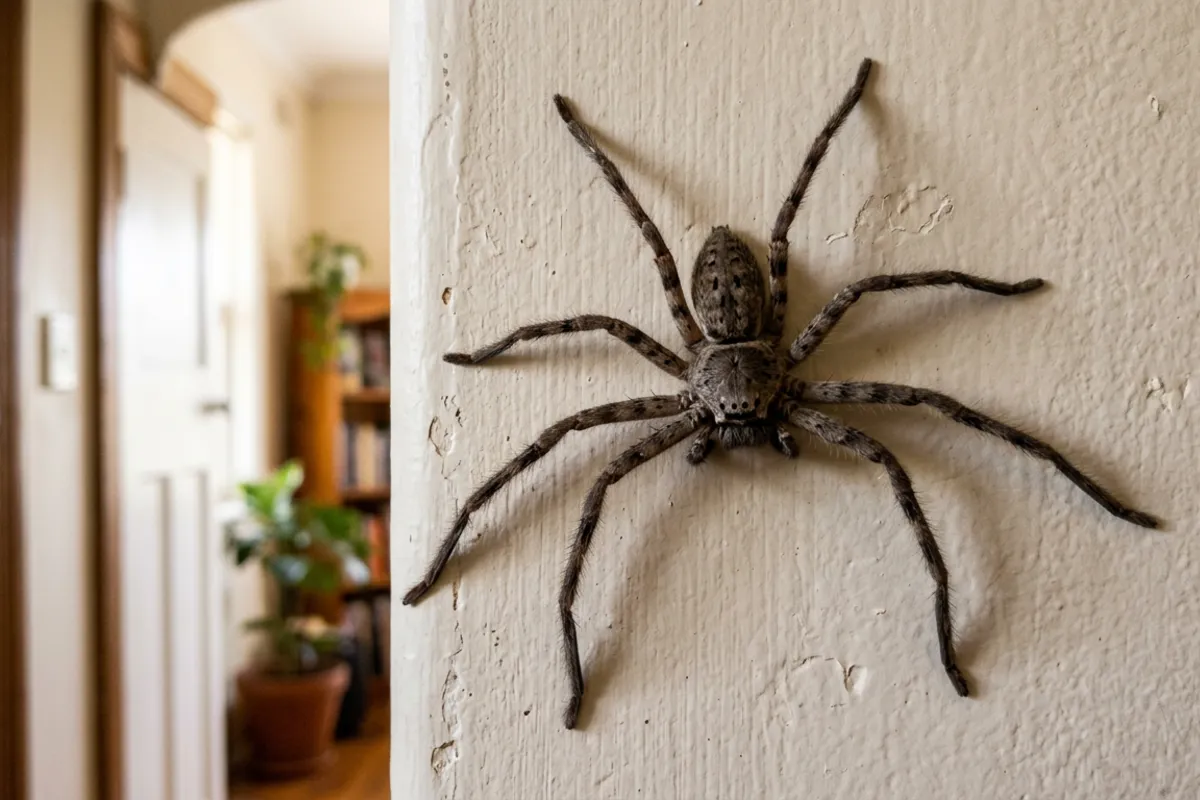
Huntsman spiders are not considered dangerous, are reluctant to bite and usually run when disturbed, with a bite causing minor effects at worst. The spider to treat as a medical emergency is an unidentified big black spider. If a huntsman turns up indoors, you can leave it alone or guide it outside with a broom.
Are huntsman spiders dangerous?
No, huntsman spiders are not considered dangerous despite their large, hairy build. They carry venom and a bite may cause some ill effects, usually if one is handled or trapped against skin, though they are reluctant to bite and normally try to escape. In Australia, only redback spiders and funnel-web spiders cause harm to humans, while bites by all other Australian spiders only cause minor effects with no major envenomation.
Huntsmen belong to the family Sparassidae, with 94 described species in Australia, and are not related to the large, hairy ground-dwelling spiders called tarantulas. A female guarding her egg sac is the exception: she stays with it for about three weeks and can be quite aggressive, rearing up in a defensive display if provoked.
For redback spiders around your property, follow our separate redback guide; we also cover white-tailed spiders indoors in a dedicated post.
What should you do if a huntsman spider bites you?
For a confirmed huntsman bite, wash the area with soap and water and apply an ice pack wrapped in a clean cloth such as a tea towel to reduce swelling and pain, keeping it off bare skin so it does not cause a cold burn. This is general information, not medical advice.
Use minor-bite first aid only when you clearly saw a large, flattened, long-legged grey or brown spider that could not be a black spider. Never apply a pressure immobilisation bandage, which is used only for funnel-web or mouse spider bites, and do not ring triple zero (000) for a confirmed huntsman bite that is only sore. See a doctor if you have a lot of pain, the bite does not settle within a few hours, swelling or itching worsens after 24 to 48 hours, or you are worried. You can also call the NSW Poisons Information Centre on 13 11 26 for advice.
If the spider was a big black spider, or if you did not see what bit you and cannot rule out a funnel-web, treat it as an emergency. Across eastern Australia, all bites by big black spiders are managed as suspected funnel-web bites for the first four hours. Call 000 for an ambulance straight away, keep the person still, and apply a pressure immobilisation bandage over the bite and along the whole limb. If it is safe to do so without touching the spider, placing an empty jar over it and sliding stiff card underneath allows it to be identified later.
People often suspect a spider bite without seeing a spider bite them. Have a doctor check any unexplained sore, ulcer or skin lesion rather than assuming a spider caused it.
Why do huntsman spiders come inside the house?
Huntsman spiders enter houses looking for tight shelter and following the insects and other invertebrates they hunt. Outdoors, they live under loose bark, inside rock crevices, in logs, under rocks and on foliage. Their flattened bodies suit narrow spaces, and they are also notorious for entering parked cars, hiding behind sun visors or running across the dashboard.
Wandering spiders can enter a house at ground level, often slipping underneath an exterior door. Door gaps, open windows and unscreened wall ventilators give both ground-wandering and climbing spiders easy access indoors.
A motionless huntsman on a wall is often an empty skin. Most species live for about two years or more and moult as they grow, leaving cast skins that are often mistaken for a live spider.
How can you tell a huntsman from a funnel-web or a wolf spider?
Check colour, surface finish and leg posture first, because body size overlaps between huntsman and funnel-web spiders.
An adult female huntsman has a body about 2 cm long (1.6 cm for a male), while her long legs give a leg span of up to 15 cm. Funnel-web bodies range from 1 cm to 5 cm, with Sydney funnel-webs typically measuring 2 cm to 4 cm. Because a huntsman's 2 cm body sits inside the 1 cm to 5 cm funnel-web range, leg span helps identify a large spider on a wall, while colour, finish and leg posture decide between them:
- Colour and finish: Huntsmen are mostly grey to brown, hairy and sometimes have banded legs. Funnel-webs are glossy dark brown to black with a shiny, sparsely haired carapace and no obvious pattern. Wolf spiders have a variegated pattern with radiating lines on the carapace and a grey or black underside.
- Body shape and leg posture: Huntsmen have flattened bodies with legs splayed forward and sideways like a crab. Funnel-webs have visible finger-like spinnerets at the rear of the abdomen and rear up to display their fangs when threatened.
- Where it moves: Huntsmen climb walls easily. Wolf spiders roam the ground at night, and their three rows of eyes (four small eyes in the front row, two above them and two higher again) glow green under a spotlight. Male funnel-webs wander at ground level at night during funnel-web spider season, most often in summer and autumn after wet weather.
| Spider | Main visual features | Typical spot | First aid if bitten |
|---|---|---|---|
| Huntsman | Flattened grey to brown body (1.6 to 2 cm), leg span up to 15 cm, crab-like splayed legs | Interior walls, behind car sun visors, under loose bark | Soap and water, wrapped cold pack, no pressure bandage |
| Wolf spider | Variegated pattern with radiating carapace lines, three eye rows glowing green in a spotlight | Along the ground at night | Soap and water, wrapped cold pack, no pressure bandage |
| Funnel-web | Glossy dark brown to black body (1 to 5 cm), shiny carapace, finger-like spinnerets | Ground level at night in summer and autumn, often after wet weather | Call 000, keep still, pressure immobilisation bandage |
If someone is bitten by an unidentified big black spider, skip the visual check and treat it as a funnel-web emergency.
Should you remove a huntsman spider from your house, or leave it?
Either is fine, depending on whether you are comfortable sharing a room with one. Inside a house, huntsmen perform a useful role as natural pest controllers by feeding on insects and other invertebrates. Leave them alone in the garden; indoors, guide one out with a broom rather than grabbing it by hand.
Huntsmen are fast moving, though not normally aggressive. If one startles you by jumping off a wall as you approach, it is trying to escape. Keep car windows and doors closed when parked, particularly at night, so one does not end up on the dashboard.
Eliminating spiders from an area for any long period is almost impossible because they do not gather in a single nest, young spiderlings disperse on the wind by ballooning, and new spiders recolonise quickly. Block the common entry routes instead:
- Fit weather strips or draught excluders along the bottom of exterior doors.
- Fit or repair fly-screens on windows and wall ventilators to keep climbing spiders out.
- Keep a cleared area around the house to discourage burrowing spiders, and wear shoes, long trousers and thick gloves when gardening.
For broader prevention steps across local species, read our guide on getting rid of spiders around your home.
When should you call a pest controller about huntsman spiders?
A single huntsman indoors rarely needs a pest controller. Call a technician when large spiders keep entering after you have sealed door gaps and fitted screens, when you cannot identify dark spiders turning up inside, or when funnel-webs or redbacks are the real concern around the home.
Avalanche Pest Control is a family-run, fully licensed and insured business servicing the Illawarra from Helensburgh to Nowra. Our spider control service applies a targeted treatment to the places spiders shelter, including eaves, weep holes, window frames, fence lines, sheds and garden edges, with a low-tox option available on request.
Call 0430 007 651 (Monday to Friday, 7am to 6pm) or get in touch through our online form.
Common questions
Are huntsman spiders dangerous to humans?
Huntsman spiders are not considered dangerous despite their large, hairy appearance. They carry venom and a bite may cause some ill effects, but they are reluctant to bite and usually run away. In Australia, only redback spiders and funnel-web spiders cause harm to humans, though a female huntsman guarding her egg sac for about three weeks can be defensive if provoked.
What happens if a huntsman spider bites you?
Bites by Australian spiders other than funnel-webs and redbacks cause only minor effects, such as local pain, swelling or itching. For a confirmed huntsman bite, wash the skin with soap and water, apply a cold pack wrapped in a clean cloth, and never use a pressure immobilisation bandage. See a doctor if you have a lot of pain, symptoms do not settle in a few hours, swelling or itching worsens after 24 to 48 hours, or you are worried. If the spider was a big black spider or was not seen and a funnel-web cannot be ruled out, call 000, keep still and apply a pressure immobilisation bandage.
Do huntsman spiders jump or attack?
Huntsman spiders move quickly, but they are not normally aggressive and prefer to run away rather than bite. If one startles you by jumping off a wall, it is trying to escape. The main exception is a female guarding her egg sac for about three weeks, which may rear up in a defensive display if provoked.
Why are huntsman spiders good to have in the house?
Huntsman spiders hunt insects and other invertebrates. Inside a house, they perform a useful role as natural pest controllers. Because they are reluctant to bite and are not considered dangerous, leaving one alone is a reasonable choice if you are comfortable having it indoors.
How big do huntsman spiders get?
Adult female huntsman spiders have a body length of about 2 cm, and males measure about 1.6 cm. Their long, sideways-splayed legs give them a leg span of up to 15 cm. That wide stance makes them look much larger on a wall than their actual body size.
What is the difference between a huntsman and a wolf spider?
Huntsman spiders have flattened, mostly grey to brown bodies with long legs splayed forward and sideways like a crab, and they regularly climb walls or shelter under loose bark. Wolf spiders have a variegated pattern with radiating lines on the carapace, three rows of eyes that glow green under a spotlight, and they hunt along the ground at night. Both are fast wandering hunters that are not considered dangerous.
How do you get a huntsman spider out of the house?
Guide the spider outside with a broom rather than grabbing it by hand. Leave it alone once it is in the garden. Fitting weather strips or draught excluders on doors and fly-screens on windows and vents helps keep wandering spiders out.
Need a hand with this in your home? Get a free quote or call 0430 007 651.