
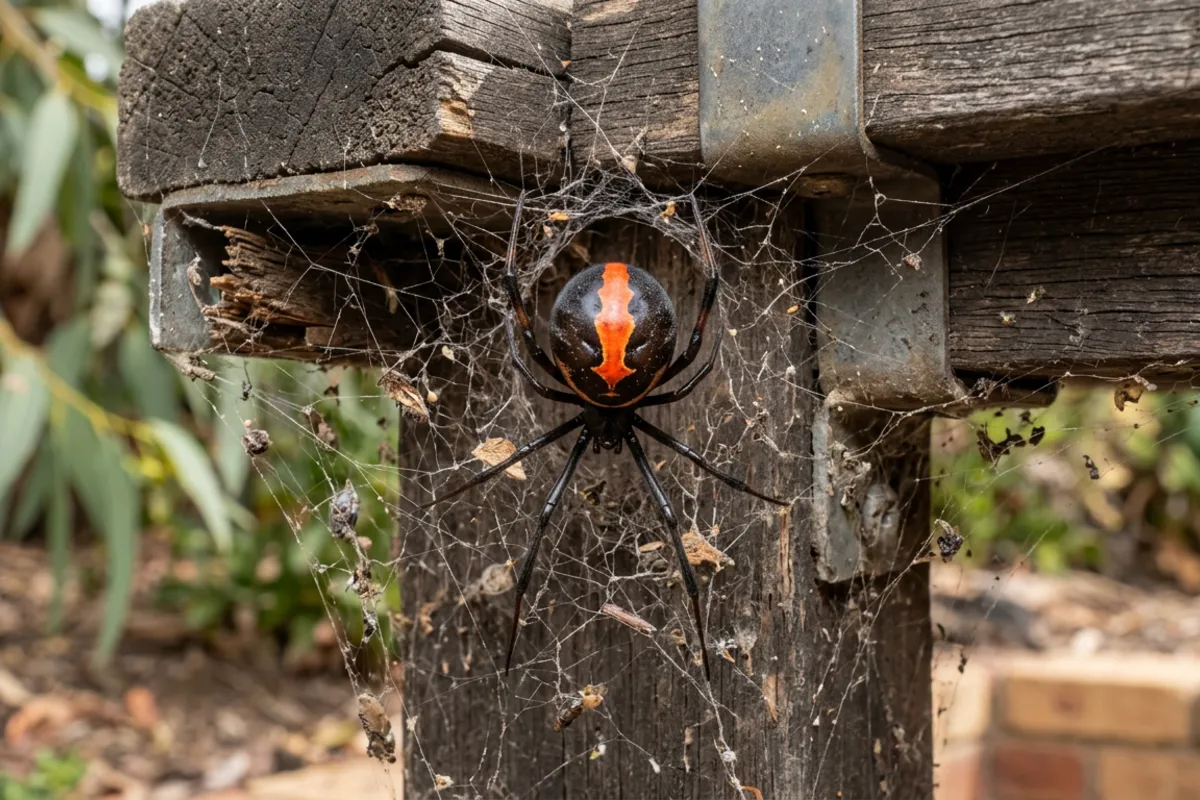
A female redback spider has a round black or dark brown body about 1 cm long, long thin legs, and a red or orange stripe on her back. The male is much smaller at 3 to 4 mm and usually has no stripe. Along with the funnel-web, the redback is one of only two spiders in Australia that cause harm to humans, though a redback bite is venomous and painful rather than life-threatening. Knowing where they shelter, how to tell them from larger black spiders, and which first aid applies makes an encounter around the house straightforward to handle.
Where do redback spiders hide around a house?
Redback spiders shelter in dry, undisturbed spots around the outside of a house and in outbuildings. Common in disturbed and urban areas across NSW, they regularly turn up under outdoor furniture, in the gap under the letterbox lid, behind pot plants, in the corners of the shed, and inside a stack of old paint tins in the garage. Further out in the yard, they settle in outdoor toilets, rubbish piles, shrubs, rocks, and logs.
Often you will notice the web before the spider. A redback builds an irregular upper silk network with a closely woven, thimble-like retreat where she shelters, plus sticky vertical catching threads running down to ground attachments known as gum-feet. That tangled, low-slung web looks very different from the grey, lacy funnel-shaped web spun by black house spiders on windows and eaves. Redbacks are less common in winter months, while spider bites occur more commonly in the warmer months.
How do you tell a redback spider from a funnel-web or other house spiders?
You can tell a redback apart from funnel-webs and common house spiders by its smaller round body, slender legs, red or orange stripe, and dry tangled web. Grey house spiders and cupboard spiders look similar enough in dim light to cause a second glance, and Illawarra homes also see black house spiders and white-tailed spiders, which are not considered dangerous to humans.
| Spider | Size and appearance | Typical location | Bite risk and first aid |
|---|---|---|---|
| Redback spider | Female about 1 cm, round black or dark brown body, red or orange stripe, long thin legs; male 3 to 4 mm, usually no stripe | Dry sheltered spots (letterboxes, under outdoor furniture, sheds, pot plants, rocks, rubbish piles) in an untidy gum-footed web | Venomous and painful, not life-threatening. Wash site, no pressure bandage, call 13 11 26. |
| Funnel-web or mouse spider (big black spider) | 1.5 to 3.5 cm, shiny black or dark brown; can rear up and bite when threatened | Outdoors around yards; male funnel-webs wander at night roughly November to April | Medical emergency. Apply pressure bandage to bite and whole limb, keep still, call 000. |
| Black house spider | Dark spider without a red stripe | Grey lacy funnel-shaped web on window frames, eaves, and wall crevices | Bites rarely, usually local pain. Treat any unidentified big black spider as a funnel-web. |
| White-tailed spider | No red stripe; commonly confused with other dark house spiders | Inside and around the house | Not considered dangerous to humans. |
Compare those measurements during funnel-web spider season, when male funnel-webs wander at night from roughly November to April. A female redback under an outdoor chair has a round body about 1 cm long on thin legs, and any male in the same web is only 3 to 4 mm. A funnel-web or mouse spider measures 1.5 to 3.5 cm, looks shiny black or dark brown, and can rear up and bite when threatened. Because those larger spiders carry a serious medical risk, any bite from a big black spider that has not been positively identified must be treated as a medical emergency with triple zero (000) and a pressure bandage rather than handled like a redback bite.
What happens if a redback spider bites you?
A redback spider bite causes local pain and redness and can bring on wider symptoms across the body, though envenomation is not life-threatening even to infants and children. Redbacks stay inside their webs and are most likely to bite when their web is disturbed, such as when a hand reaches under a letterbox lid, beneath an outdoor chair, or into a gardening glove left in the shed.
Typical symptoms include pain and redness at the bite site, sweating, nausea, vomiting, and headaches, and some people also develop muscle weakness or spasms. Most redback spider bites can be treated at home. No deaths have been reported since the mid-1950s, and antivenom is no longer supported in NSW as part of routine management, so hospital care is focused on managing severe symptoms if they develop.
What first aid should you do for a redback spider bite?
For a confirmed redback spider bite, wash the area and keep it clean, leave off any pressure bandage, and call the NSW Poisons Information Centre on 13 11 26 for advice. Go to the nearest hospital if symptoms are severe. Do not apply a pressure bandage for a redback bite, because pressure immobilisation is used for funnel-webs and unidentified big black spiders, whereas redback bites are left unbandaged.
If the spider was a big black spider and you cannot confirm what species it was, switch immediately to funnel-web first aid:
- Apply a pressure bandage around the bite and the whole limb.
- Keep the person still.
- Call triple zero (000) and ask for an ambulance, and ring 13 11 26 while waiting for help.
How do you keep redback spiders away from the house?
You reduce contact with redback spiders by clearing dry outdoor clutter and checking sheltered spots before reaching in. Small routine habits around the yard and shed help stop accidental bites:
- Wear gloves when moving pot plants, rocks, logs, or old tins stored in the garage and shed.
- Shake out shoes and gardening gloves left outside or in the shed before putting them on.
- Look underneath outdoor furniture and under the letterbox lid before putting your fingers in.
- Clear rubbish piles, unused pots, and stacked clutter away from doorways, patios, and paths.
For ongoing control around Illawarra yards, see our guide to getting rid of redbacks and funnel-webs around your home.
When should you call a pest controller about redback spiders?
Call a licensed pest controller when redback webs keep rebuilding around your letterbox, outdoor furniture, shed, and doorways after you clear clutter, or when you want a targeted perimeter treatment ahead of the warmer months. By law in NSW, anyone carrying out prescribed pesticide work must hold a pest management technician licence issued by the NSW EPA, and licensed technicians may only use registered pesticides covered by a label or permit.
Avalanche Pest Control is a family-run, fully licensed and insured team based in Wollongong, servicing homes from Helensburgh to Nowra. Our spider control treatment targets eaves, weep holes, window frames, fence lines, sheds, and garden edges, with a low-tox option available on request. Treated areas are safe once dry, usually within a couple of hours, most homes notice a big drop within a few days, and a treatment typically holds for several months.
Call us on 0430 007 651 (Monday to Friday, 7am to 6pm) or get in touch through our online form.
Common questions
What does a female redback spider look like compared to a male?
A female redback has a round black or dark brown body about 1 cm long, long thin legs, and a red or orange stripe on her back. The male is much smaller, measuring 3 to 4 mm, and usually does not have a stripe.
Are redback spider bites fatal?
No. Redback bites are venomous and painful, but they are not life-threatening, even to infants and children. No deaths from redback bites have been reported since the mid-1950s.
Should you put a pressure bandage on a redback spider bite?
No. Do not apply a pressure bandage for a confirmed redback bite. Wash the area, keep it clean, and call the NSW Poisons Information Centre on 13 11 26. Pressure bandages are used for funnel-web bites and bites from unidentified big black spiders.
Is antivenom still given for redback spider bites in NSW?
Routine antivenom is no longer recommended or supported in NSW for redback bites. Most redback bites can be managed at home with advice from 13 11 26, and hospital care is reserved for severe symptoms.
Where do redback spiders usually hide around Illawarra homes?
They build untidy webs in dry, sheltered, undisturbed spots such as inside letterboxes, under outdoor furniture, behind pot plants, in shed corners, inside stacked tins in the garage, and among rocks, logs, shrubs, and rubbish piles.
When are redback spiders most active?
Redback spiders are found all over NSW throughout the year, but they are less common in the winter months. Spider bites happen more often during the warmer months when both spiders and people are more active outdoors.
Need a hand with this in your home? Get a free quote or call 0430 007 651.